


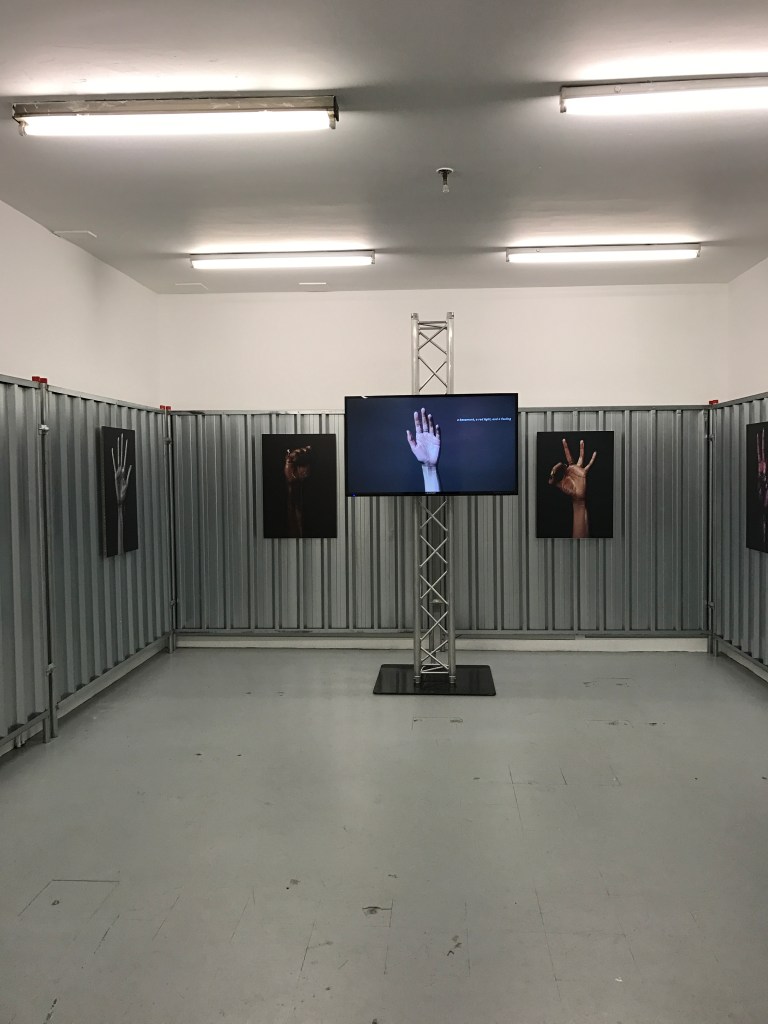

 On the weekend of 10th and 11th December 2016 Open School East (OSE) hosted a weekend showcasing the work of its Class of 2016 in-house artists. OSE is an Arts Council, Lottery funded and sponsored free year of art school for 16 students where teaching is provided by volunteer master artists, cultural studies lectures (available to the wider community too) from UEL and through peer learning. Sadly for Londoners this is the last time OSE will be based in De Beauvoir, Hackney as rent hikes and changes mean they are moving to Margate in the New Year.
The weekend events combined a mixture of exhibition, performance, films and a convivial atmosphere culminating in a communal meal on Sunday evening.
Amongst the exhibitions is Gates of Rome (2016) by Henry Babbage and Louis-Jack Horton-Stephens; a mixed media installation, the walls of the room are lined with steel hoarding and music and video recalls the feel of a night club. All around the room and on the video images are hands coated in clear, slick, plasticky liquid making universally understood hand gestures used often by politicians. To me these could equally be hands rising from a sticky coated club floor the bodies of their owners having fallen into its depths. Either way the installation was strangely compelling.
A reading group on Saturday afternoon gathered to read and discuss selected writings and poems on the topic of Future Fossils; After Effects. Hearing the different voices reading a paragraph at a time is part of the enjoyment and when a German woman who speaks French better than anyone else in the room reads a section in that language and others explain aspects of political theory or knowledge of Walter Benjamin’s opus ‘The Arcades Project’ a sharing of knowledge is invoked. I am privileged to read a poem by Aasb Berg, from her book Dark Matter, one of three poems we read by her all of which raise questions of the body, matter and reality in a way that compliments the academic readings.
Emil Scheffman presents ‘A Year to Forget’ his year in photographs and shares with us moments that have supported him adapt to a new life in London from his native New Zealand that are funny, sentimental, witty and charming and include an art theft (possibly) witnessed, recorded but not stopped. His other work being exhibited is more confused however, trapping photos under and tamarind seeds on a plastered board on top of which faint writings cannot be made out.
What looks like an onsite sponsorship and sale demo of the Nutri-bullet turns out to be an ironic assessment of the pressure towards good health, perfection and capitalism as our sales lady Eleanor Davies explains the benefits and post-ironically leaves us all with a cleansing green shot of something probably loaded with iron.
I watch a performance and site specific installation by Tannu Kotecha ‘An Invitation to a Silent Conversation’, as she conducts her asemic writings (here – an invented calligraphy on linen) in serenity and a sort of meditation the inscribed linen flows to the ceiling and then down and out the window whereupon it is freed only to be battered by the cold, rain and wind outside. It is a nod also to the intent of OSE to enable the works of art to be shared and enjoyed by the community and the struggle that can be to achieve. It is a beautiful piece somewhat marred by bad curation which has set up a video documentary by Alex Ressel and Kerri Meehan about the Taxonomy of the Platypus somewhat shattering the silence in the room and which is in fact required in Kotecha’s piece. This latter video is well edited and narrated but despite being presented together with small ceramic sculptures, which perhaps were intended to raise the question of people as creators, they instead raise different questions including why are they with this video? Together video and sculptures don’t manage to ask ‘why did European scientists fail to accept the reality of the platypus?’ or maybe even ‘where might scientists be failing today ?’ they simply re-package the story. Theo Shield’s found metal and glass sculptures on display in the same room are delightful explorations of matter and form revealing the liquid nature of molten glass through the end state of the resulting works.
In ‘a Fifth Empire’ Joel Sines presents a glimpse of a future film based on identity, memory, de-colonialisation and culture.The works draws on the poetry and writings of Fernando Pessoa, Agostinho Neto and Amilcar Cabral an imagined tapestry linking them all. It is the beginnings of a film that will explore migration, integration, community, language and place. We travel high seas in container ships and see Portugal’s multicultural team win the 2016 European Championship beating France’s multicultural team; ponder the meaning of transitions between Portuguese handmade tiles and the Portuguese Man of War; and it makes us consider both past and possible futures.
Annette Kampan’s ‘Performance Figures.Figure.Stuck’ in which she stands back to us on a long white cloth which forms the landscape to her piece. As she hums, talks and sings through a journey she moves backwards towards us and only later I notice the text laid out under her feet. Her voice is strong and beautiful and the piece raises questions of control, space and the use of language but is mainly just an enjoyable event. Less so the film she collaborates on with Rosie Morris and the Florence Lawrence Choir shown afterwards. A reflection on the life of Florence Lawrence the first ever female film star and as such a star of silent movies but who was exploited by her film company at the time. The story is accompanied by the presence of an all white, 11 woman choir dressed in black staged in various poses but not moving and stuck singing or humming repetitive segments. Their voices are neither articulate to contrast with the silent film nor silenced in sympathy nor, as I suspect intended, reverential. The best bit is the overlayed silent movie, in which to give her the name the choir does, Flo Lo outshines them all.
On Saturday night there is a collaboration between a number of the artists, visitors and guests to order in pizza as it’s late, raining and everyone is hungry. This turns into a bit of a performance itself and it is also Anni’s birthday so a cake is cut and shared out too. I’m invited to return for the dinner the next night and delightedly accept.
On Sunday I arrive at 4pm, sadly missing a number of events, but managing to attend the viewing of Ashik Kerrib (1998) a film by Sergei Parajanov, the late soviet-armenian film director, which is presented by a artist’s Anni Movsisyan and Joel Simes. The films retells an old fable and initially I wonder where the value lies in this old fashioned story but it is filmed beautifully overlaying art, costume, music, dance, landscape, color in a rich cinematography. During the discussion afterwards I learn that the degree of cultural and religious imagery in Parajanov’s films landed him in Russian jails for 15 years and that given the harsh circumstances he was in the films he made were considered very subversive. We reflect on the use of images of singer sewing machines and fake machine guns which pull the story out of fairytale times from long, long ago into a strange ‘any time’ ancient or modern or both. It seems to speak to past wars and today’s refugee crisis. The lack of concern for the quality of the acting is discussed as not being a problem as the storytelling is done throughout in other layers; there is discussion of magic and ritual and their importance in life and filmmaking. The discussion goes on with the remaining few until we are hungry and go to join the dinner in the main hall.
I had been told that the dinner was intended to be a disruptive Christmas meal where we would discuss tactics for dealing with our real and potentially fraught family Christmas dinners. I bring Saxo stuffing as an offering to that intent, invoking 1970s trad dinners. Alex manages to make space for it in the small oven. All the artists have collaborated with external artist/tutor Michael Rakowitz to create this communal feast. He has roasted a chicken inside a duck as the centerpiece and tells us that the salt used for the whole meal was scraped from Robert Smith’s spiral jetty (or some land art somewhere by the sea) and crushed and shared in this meal. Other ingredients are given equally exotic provenance but my stomach is rumbling and I don’t recall. No one at my table wants to discuss difficult family gatherings as we are all looking forward to ours and this meal is more of a celebration than a planning event for future concerns.
The whole weekend is a very 2016 happening with not much in the way of sex, drugs and rock and roll but plenty of art, thought and community and thoroughly enjoyable.
 Art Urban